Impact
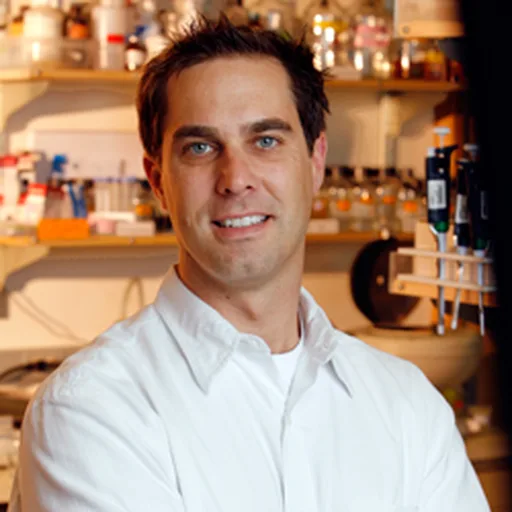
Andrew Dillin studies why ageing organisms lose control of protein quality (proteostasis) and how stress signals are communicated between tissues to set the rate of ageing. Working mainly in C. elegans, with extensions to stem cells and mice, his laboratory showed that mitochondrial stress in one tissue can be sensed by distant cells, triggering a cell non-autonomous mitochondrial stress response that extends lifespan (Cell, 2011). His group has also identified regulators of longevity downstream of AMPK and calcineurin signalling (Nature, 2011), linked proteasome activity to longevity and to human embryonic stem cell function (Nature, 2012), and studied how the heat-shock transcription factor HSF-1 influences lifespan and thermotolerance. Earlier work showed that the timing of mitochondrial function during development affects rates of behaviour and ageing. He has been a Howard Hughes Medical Institute Investigator since 2008 and is Professor of Immunology and Molecular Medicine in the Department of Molecular and Cell Biology at UC Berkeley. His 2025-2026 publications include reviews of cross-organ mitochondrial communication and work on mitochondrial dysfunction linked to an ALS mutation.
Metrics
- h-index 77 · google scholar as of 2026-09-23 source ↗
Research output
193 works · 30,851 citations · h-index 72 OpenAlex ↗
Selected publications
- Phosphorylation of ULK1 (hATG1) by AMP-Activated Protein Kinase Connects Energy Sensing to Mitophagy ↗ 2010 · 2,639 citations
- Adapting Proteostasis for Disease Intervention ↗ 2008 · 2,557 citations
- ULK1 induces autophagy by phosphorylating Beclin-1 and activating VPS34 lipid kinase ↗ 2013 · 1,587 citations
- Biological and Chemical Approaches to Diseases of Proteostasis Deficiency ↗ 2009 · 1,169 citations
- Rates of Behavior and Aging Specified by Mitochondrial Function During Development ↗ 2002 · 1,161 citations
Research funding
44 NIH awards · USD 17M total NIH RePORTER ↗
- Neuroendocrine Coordination of Mitochondrial Stress Signaling and Proteostasis National Institute of Environmental Health Sciences · 2023 · USD 1M
- Postgraduate Training Program in Genetics National Institute of General Medical Sciences · 2014 · USD 550K
- Postgraduate Training Program in Genetics National Institute of General Medical Sciences · 2015 · USD 509K
- The Perception of Mitochondrial Stress in Receiving Cells National Institute on Aging · 2020 · USD 410K
- The Perception of Mitochondrial Stress in Receiving Cells National Institute on Aging · 2019 · USD 410K